Describe the Morphology and Anatomy of Mollusks.
15 - Describe the feeding mechanism of sponges and. Mollusks have many features in common with annelids and arthropods such as bilateral symmetry triploblasty ventral nerve cords and a coelom.
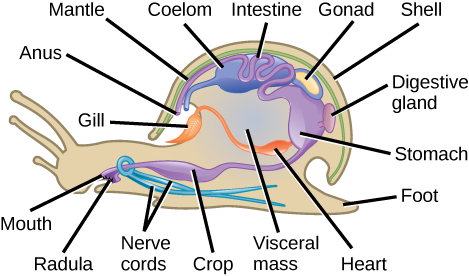
14 4 Phylum Mollusca Biology Libretexts
Along with the insects and vertebrates it is one of the most diverse groups in the animal kingdom with nearly 100000 possibly as many as 150000 described species.

. This is all covered with a mantle also known as a pallium that typically secretes the shell. They are smooth-bodied bilaterally symmetrical stratified coelomate animals. General Characteristics of Phylum Mollusca.
In gastropods the shell contains only part of the body. Glossary Annelida a phylum of worm-like animals with metamerism chaeta a chitinous. 15 - Describe the morphology and anatomy of mollusks.
Excretion takes place by paired metanephridia kidney. The body is divided into head muscular foot and visceral mass. All molluscs have a tissue that covers the animal called the mantle which is sometimes involved in shell secretion and respirationMolluscs also have a unique set of feeding structures including the radula a chitinized strip that bears.
Some molluscs like bivalves and gastropods secrete an external calcareous carapace the shell. The mollusks anatomy consists of a circulatory system a nervous system and a digestive system which vary between the various classes. They have a variety of forms ranging from large predatory squid and octopus some of which show a high degree of intelligence to small grazing forms with elaborately sculpted and colored shells.
There are many species and variations of mollusks. Mollusk also spelled mollusc any soft-bodied invertebrate of the phylum Mollusca usually wholly or partly enclosed in a calcium carbonate shell secreted by a soft mantle covering the body. Presence of one pair tentacles except octopus where tentacles are modified into arm.
Textbook solution for Biology 2e 2nd Edition Matthew Douglas Chapter 28 Problem 30CTQ. Calcium carbonate is secreted by the mantle a fold in the epidermis forming the shell. Head consists tentacles and compound eyes.
The body of molluscs is un-segmented with a distinct head muscular foot. Molluscs also known as molluscs are the second-largest phylum of invertebrate animals after Arthropoda. Mostly aquatic and few are terrestrial.
In pelecypods the shell is made of two valves that articulate and contain the individual body within. The proportion of undescribed species is very high. Describe the morphology and anatomy of mollusks -a large muscular foot that may be modified into tentacles but it functions in locomotion.
The number of fossil species is estimated between 60000 and 100000 additional species. Eyespots and statocysts may be absent in some species. They have a mantle a structure of tissue that covers and encloses the dorsal portion of the animal and secretes the shell when it is present.
Sense organs are eyes tentacles osphradium. Circulatory system is closed or open type. General Characteristics of Phylum Mollusca.
The annelids traditionally include the. Visit the mollusca pages on the Tree of Life for more on molluscan systematics. Despite their amazing diversity all molluscs share some unique characteristics that define their body plan.
15 - Sessile adult tunicates lose the notochord. Describe the morphology and anatomy of mollusks. Describe the morphology and anatomy of mollusks.
This illustration shows the anatomy of an aquatic gastropod. They are mostly marine. -They have a mantle a structure of tissue that covers and encloses the dorsal portion of the animal and secretes the shell when it is present.
Describe the morphology and anatomy of mollusks. The mollusks are a diverse group 85000 described species of mostly marine species. Mollusks have a large muscular foot that may be modified in various ways such as into tentacles but it functions in locomotion.
15 - Compare the structural differences between. They have a mantle a structure of tissue that covers and encloses the dorsal portion of the animal and secretes the shell when it is present. Unlike annelids mollusks with one.
The radula is usually used for scraping food such as algae from surfaces. Describe the features of an animal classified in phylum Annelida. The digestive tract of the Mollusca is complex.
Body is soft without segmentation. They have a mantle a structure of tissue that covers and encloses the dorsal portion of the animal and secrete the shell when it is present. Mollusks have a large muscular foot that may be modified in various ways such as into tentacles but it functions in locomotion.
Usually shelled with a mantle ventral foot anterior head and visceral dorsal mass. Mollusks have a large muscular foot that may be modified in various ways such as into tentacles but it functions in locomotion. The body has a head a foot and a visceral mass.
Describe the morphology and anatomy of mollusks. Molluscs are very diverse animals and make up a significant part of the. Describe the unique anatomical features of mollusks.
Morphology Despite their amazing diversity all molluscs share some unique characteristics that define their body plan. Describe the unique anatomical and morphological features of mollusks. In this article we will discuss about the general characters and classification of Phylum Mollusca.
15 - Describe a potential advantage and disadvantage of. Mollusca is the second-largest phylum of invertebrate animals after the Arthropoda the members of which are known as molluscs or mollusks ˈ m ɒ l ə s k Around 85000 extant species of molluscs are recognized. 15 - Speculate as to what advantages a complete.
The overall morphology is laterally flattened and the head region is poorly developed. Many however occur in fresh water and some even in damp soil. We have step-by-step solutions for your textbooks written by Bartleby experts.
The foregut region consists of an esophagus and a mouth cavity which contains a toothed belt called the radula found in almost all mollusks and peculiar to the phylum. The mollusks are a diverse group 85000 described species of mostly marine species. The morphology and anatomy of modern bivalves have been much altered from those of ancestral mollusks which had a distinct anterior end with a.
The number and form of radula teeth are highly. Nervous system consists of many paired ganglia connectives and nerves.
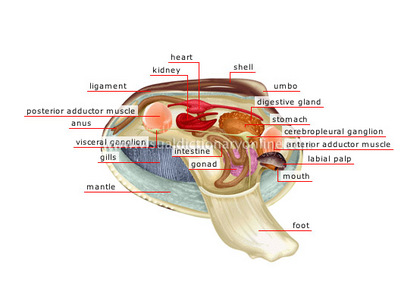
Bivalves Cephalopods And Gastropods Mollusks
Phylum Mollusca Biology For Non Majors Ii

28 3e Phylum Mollusca Biology Libretexts

Anatomy Of Molluscs Molluscs Animal Infographic Animal Science


Comments
Post a Comment